Wednesday, March 01, 2006

Snow, Clear Skies and Sun


Snow, Clear Skies and Sun in Stirlingshire but blizzards brought chaos to the Highlands and the North yesterday as Scots were warned to think twice about taking to the roads. Forecasters also said there were more blizzards on the way.

Scotland has such changeable weather and you never can tell what will happen during the course of a single day. However the good news is that I have been able to bag some really good photographs for our 2007 scottish calendars.

We have seen little sun at all in the central belt during January and February while our friends in the North have been enjoying some good days.

Last week I visited Glencoe where the clear skies over newly fallen snow on the rugged peaks of Buchaille Etive Mor made taking more photographs an absolute joy. Look out for the pictures when we have our new web pages up and running at www.flavell.com .

The weather improved even more over the weekend for those of us who were lucky enough to be in the West. I had a chance to visit Culzean Castle which you will see featured in our Scottish Castles Calendar for 2008. I know it is a long way off but we print and publish the Scottish calendars 12 months in advance. Look out for this years Scottish Calendars in tourist shops around Scotland.

Yesterday and To-day have been fine days again and I have spent some time taking more photographs in the Trossachs.

Remember when you visit Scotland to bring clothes for all seasons

Yours Aye

Gordon Flavell

www.flavell.com

Monday, February 27, 2006

Scotland believe this is only start of process as new belief takes hold

LIKE dehydrated desert nomads who suddenly find a spot of water, Scotland have spent the weekend drinking deep at the well of victory. To put the victory in perspective, it is only the third over England in 20 years, and the first time since 1990 that they have beaten both the Auld Enemy and France in the same season.

This is how the 'Times' saw the Rugby game which took place at Murrayfield this weekend. Scotland and England were playing for the Calcutta cup which is one of the oldest fixtures in the sport's history.

There is always keen rivalry between the two teams especially since Scotland are traditionally the underdogs - not surprising really when you think England has the choice of 92% of the population.

I am hoping that this will give us all in Scotland renewed vigor for the year ahead and encourage more visitors to our interesting country. This was also one of our best days for our retail partners in Edinburgh who sold many of our notebooks and pads featuring our national flag- the saltire.

Yours aye

Gordon Flavell

www.flavell.com

Saturday, February 18, 2006

Rolling Stone Gathers Some Satisfaction for a Scot

PINEROLO, Italy, Feb. 15 — Rhona Martin returned to Scotland four years ago a national hero, extolled as a homemaker superstar for leading Britain's curlers to the gold medal at the Salt Lake Olympics on the match's final shot: the "stone of destiny."

A smitten London Telegraph columnist wrote about her Everywoman appeal, "You could offer her sapphires, diamonds, rubies and she would tell you only one stone is precious to her." That bauble is the 42-pound granite stone that curlers push down sheets of ice toward a bull's-eye called the house.

She and her teammates were hailed as golden girls. One headline gushed, "Home Are the Heroes, Home From the Lake." Nearly six million people in Britain had watched them win.

I liked the headline from the New York times about our ladies curling team - especially on the day when the Rolling Stones are giving a free concert to over 1 million people on the Copacabana beach in Rio de Janeiro.

However the ladies are not doing as well as ourmen'ss team in Italy but lets hope for the best. For those of you who don't know much about curling here a few facts.

Curling is a precision sport similar to bowls or but played on ice with heavy polished granite stones. The game is generally believed to have been invented in 16th century Scotland.

Curling outdoors on the frozen lochs was very popular between the 16th and the 19th centuries when the climate was cold enough to ensure good ice conditions every winter, and as a result the international governing body for curling, the World Curling Federation is based in Perth which is only a few minutes away from me here in rural Perthshire.

Curling has been an official sport in the Winter Olympics since 1998.

The origins of the word curling are not known. It was first used in print in 1630 in Perth, Scotland. Also known as "the roaring game" (because of the sound the stones make whiletravelingg over the pebble), curling probably does not take its name from the motion of the stones.

In the early history of curling, the rocks were simply flat-bottomed river stones which were sometimes notched or shaped; the thrower had little control over the rock, and relied more on luck than skill to win. Look out soon for our Scottish Calendars featuring the lochs where they curled all those years ago.

One possible derivation is that it came from the old verb curr which describes a low rumble. Nevertheless, today a rock which deviates from a straight line is said to curl.

Yours aye

Gordon Flavell

www.flavell.com

Tuesday, February 14, 2006

Scotland is top for Valentine's Romantic spots


According to Scottish Television to-day - Being Valentines Day, romantic Scots are being reminded that the perfect place to spend it may be closer to home than they might think.

National tourist body, VisitScotland has launched a new website highlighting ideal locations to have a memorable break.

Scotland has become increasingly popular for romantic breaks, with celebrity couples such as Madonna and Guy Ritchie opting to holiday north of the border.

I'm not sure which particular part of Scotland I would call the most romantic. Having photographed most of our famous beauty spots for our scottish calendars there are so many to choose. The Trossachs looking down over Loch Katrine, Elgol on Skye, The Blacksmiths Cottage at Gretna Green, The peace of Knoydart, The enchanted forest at Dunkeld, The Beaches on the Western Isles or what about Picnics on Loch Lomond.

I hope you can come and see them all

Yours aye

Gordon Flavell

www.flavell.com

Wednesday, February 08, 2006

What is a Scottish Clan


Clan from the Gaelic for children can be defined more easily as a group of people which is made up from a number of families with common ancestors.

These family groupings are accompanied by a further number of dependent and associated families who have either sought the protection of the clan at some point in history or have been tenants or vassals of its chief.

Traditionally that chief is owed allegiance by all members of the clan. Allegiance was generally given to a father's clan, but Celtic tradition includes a strong element of descent through, and loyalty to, a mother's line.

However it was common practise for the clan chief to adopt into the family those people with the necessary skills to help the local clan cause. They in turn would normally adopt the clan surname.

To further complicate matters there are also a Clan Sept A Sept is a family name which can be related to a clan or larger family for various reasons: Either through marriage or by seeking protection from a larger and more powerful neighbouring clan or family.

Many of the names which are recorded as septs have since become clans in their own right and many can be related to more than one clan.

We have a list of over 100 clan names in our clan stationery range which are in common usage today. Most of these clans have a current chief and many are still in the great castles and houses of Scotland.

Yours aye

Gordon Flavell

www.flavell.com

Sunday, February 05, 2006

The Isle of Bute in the Clyde

Yet another hectic weekend - We were involved in the printing of the programmes for the annual showbiz ball in Glasgow. As you can imagine a very glitzy night.

The committee decided this year to include one of our pocket and bag notebooks as a gift for the guests along with some other goodies. I will put a photo of them on the site soon.

We also had time to visit some of our clients on the west coast. It was a fantastic day as we drove down the clyde and stopped off for a bite of lunch overlooking Rothesay on the Isle of Bute where you can find wonderful luxury self catering accommodation. From there you can look over to the isle of Arran.

Bute is a beautiful accessible island, which is 15 miles long and 4 miles wide. It is situated in the Clyde estuary on the west coast of Scotland and about 35 miles from Glasgow. It has a good road network and is serviced by frequent car ferry service from the mainland .

The trip on our rib is about 20 minutes but if you have to take the ferry, the journey is 35 minutes and there are sailings throughout the year. There is also a year round ferry service from the north end of the island to the mainland. There is a rail connection to the ferry terminal at Wemyss Bay.

Yours aye Gordon Flavell
www.flavell.com
Images of Scotland for you to take home

Thursday, January 26, 2006

Glasgow Calendar Celtic Connections


We have just returned from five very hectic days at the Scottish International Gift Show in Glasgow. Featured is the best of Scottish craft and gifts.

So - Thanks for all of you who took time to visit us at the show in Glasgow. Glasgow is great city full of vibrance and buzz, especially just now since the Celtic connection music festival is taking place. Architecture in Glasgow is predominently Victorian and the city centre is full of fine buildings. Take time to visit the museums and galleries which have a surprising amount of parkland surrounding them. Later in the year I shall take some new photographs and highlight some of the main place to see.

I am pleased that so many of you liked our new products and stands. This will keep our new acrylic bending machine busy for a while. You were also very enthusiastic about our Scottish Calendars and we will have more new titles later in the year.

The new catalogue pages will be up on the site fairly soon - anything you need meantime please call or email Jane.

Friday, January 13, 2006

Scottish Calendar 2006


Happy New Year

2006 has arrived with a little blue sky and also bracing winds and rain. There have been some stunning storm colours in the sky which are just right for a scottish calendar.

As usual we have taken thousands of scottish photographs during the year and have placed them in our series of Scottish calendars.

Look out for the Scottish Castles mini calendar and of course the Scottish Lochs and Mountains mini calendar which are available in good tourist stores around Scotland.

I will bring you some interesting stories during the year. Apparently new statistics are pointing to a significant increase in visitors to our shores which is very encouraging for all of us who appreciate all that Scotland has to offer.

If you haven't been to Scotland yet- why not make 2006 the year to visit.


Yours aye

Gordon Flavell

www.flavell.com

Friday, December 30, 2005

Hogmanay in Scotland


Hogmanay: it's the one night of the year when everyone wants to be Scottish, taking part in the world-famous hedonism of the New Year celebrations, singing the centuries-old words of Robbie Burns in a rendition of Auld Lang Syne . Why is 31st December so inextricably linked with Caledonian capers and enchanted Celtic rituals?

According to the BBC, the origins of Hogmanay are a heady mix of arcane customs, Celtic revelry and pagan behaviour. The word itself probably comes from the Old French aguillanneuf, meaning the "last day of the year", harking back to a time when gifts where given and received. Because people used to go round houses guising for food, the day was also known as Cake Day.

John MacTaggart, writing in 1824, has a most intriguing explanation of the word's origins:"I think Hog-ma-nay means hug-me-now." MacTaggart proposed that the word comes from a time when kissing to greet someone was a more common greeting.

It is a great time of year to be Scottish. There are now celebrations in most towns and cities across Scotland. The party in Edinburgh draws a huge number of party goers and is well worth visiting.

Here from our Scottish Christmas card collection a picture of Edinburgh Castle from Charlotte Square at the west end of George Street.

Wishing you all the best for 2006

Yours Aye

Gordon Flavell
www.flavell.com

Monday, December 26, 2005

Christmas time in Scotland


Happy Holidays

You definitely need a tree for Christmas - and the best place to find one is from the Forestry Commission.

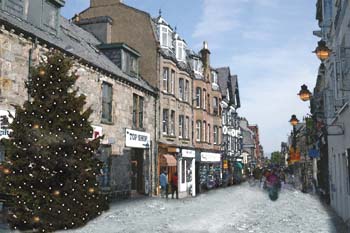
Many of our local Christmas cards feature either town christmas trees or snow scenes in one of the many Scottish forests.

All Forestry Commission Christmas trees are grown specially to be sold during the festive season. When they are cut, they are between 6-10 years old - and two more are planted to replace each one.

The custom of putting up a decorated fir tree in your home at Christmas began in Germany in the 17th century and in turn were introduced to Britain by Prince albert.

There are three main types of Christmas trees sold in Britain:-
1. Norway spruce - regarded as the most traditional tree - a 4 foot tree contains some 150,000 needles

2. Scots and lodgepole pine which have soft foliage and hold needles well

3. Noble and Nordmann fir which hold needles the best and are probably thye most popular

Around 6 million trees are sold in Britain each year of which the Forestry Commission provides around 100,000 trees. For every tree cut they plant at least another two.

In 2004 they planted 150,000 Christmas trees. About half were Noble fir, which is the best Christmas tree for holding its needles. Growing times: Pine (5 years); Spruce (7 years); Noble Fir (10 years).

Yours aye

Gordon Flavell
www.flavell.com

the home of advertising pads and promotional printing.

Saturday, December 17, 2005

Snow in Fort William


Nestling under the majestic peak of Scotland's highest mountain Ben Nevis lies the popular tourist town of Fort William. Another illustration from our local christmas card series.

Fort William , the largest town within Lochaber region of the western highlands. is a major area for all round outdoor sports - skiing and mountaineering in the winter and for walking, golf and watersports in the summer.

Take in the highland culture with all its clan history. Visit the castles, distilleries and quiet country areas and enjoy the hospitality of the friendly people with a big welcome.

Yours aye

Gordon flavell
www.flavell.com

.

Wednesday, December 14, 2005

Where is Santa


Santa would have been upset to-day if he had heard the news that DEER grazing at a notorious traffic blackspot near Blair Athol in Perthshire were being culled last night to cut down on accidents.

The decision was made after 12 dead roe and fallow deer, thought to have been struck by cars, were found on a two-mile stretch of the A9 in Perthshire over a 10-day period.

I have traveled many times along that road and at night you can see dozens of deer grazing by the road side. It is a great opportunity to get near them for photographs for our local calendars but of course you can't stop on the road.

Marksmen from the Murthly and Atholl Estate, which owns the land bordering the road, went out to shoot the deer at 11pm last night. Watch out Rudolph!!

yours aye
Gordon Flavell
www.flavell.com

Monday, December 12, 2005

Golf at Gleneagles in the snow


Blue skies, crisp snow - what more could you want for a day out at Gleneagles in Perthshire. This top luxury hotel nestling between the Ochil Hills to the South and the Strathmore Hills to the North has not one but three championship golf courses.

The local Scottish Christmas card of the snow here at the starters box of the PGA Centenary course has always proved popular.

This is what the hotel has to say about the course

From the back tees, the PGA Centenary Course measures 7,088 yards, the longest inland course in Scotland. However, the tees are graded at each hole in five stages, including a challenging 6,558 yards from the white markers down to 5,072 from the red.

Fittingly, the PGA Centenary Course begins by playing southeast towards the famed glen of the eagles sweeping up the Ochil Hills to the summit of the pass below Ben Shee which joins it to Glendevon.

Putting on the two-tier second green, you are distracted by the lush panorama of the rich Perthshire straths. As you move westwards over the next few holes, the rugged Grampians come into view on the right, then distantly purple ahead, Ben Vorlich and the mountains above the Trossachs.

It is certainly a place of incredible beauty and chosen as the venue for the G8 summit of world leaders earlier this year.

In the winter watch the pheasants, ducks and partridge meander across the fields. If you are a golfer this is one place you shouldn't miss.

Yours aye

Gordon Flavell
www.flavell.com

Sunday, December 11, 2005

Scottish Local Christmas Cards


Over the next few weeks I am going to post some of the scenes from our local Scottish Christmas cards series. Some are photographic and some are illustrations. They have been incredibly popular this year and we have ended up with images of more and more towns .

For those of you from further afield, I will also relate some interesting facts from each of the towns that we visit. Hopefully that way you will get to know more about where we are.

Our first visit is to Paisley Abbey. Paisley is 7 miles to the west of Glasgow and is on the river Cart. The townsfolk are known as 'Buddies' and the local football team is St Mirren managed for a while by namesake but no relation Bobby Flavell.

Famous for its threadmaking by the Clark family and Coats family who were originally rivals but merged together in the late 1800's. When passing the town make time to visit the Coats Observatory. Look out also for the Paisley Pattern a teardrop shaped pattern originating probably in India which appeared mostly on shawls which were copied and produced locally.

Yours aye

Gordon Flavell
www.flavell.com

Saturday, December 10, 2005

Controversial Giant Pylons set for Scotlands Beauty spots


Are we going to spoil this view?

Plans are well ahead to create 600 electricity pylons between the pretty village of Beauly near Inverness in the Highlands and Denny, near Falkirk. This 130 mile cable would run through some of Scotland's finest landscape including the Cairngorms National Park. It passes over the Ochil hills and are within sight of the Wallace Monument in Stirling.

arguments have been well publicised by those who want to keep the beauty spots free from industrial pollution. There are also economic repercussions for those in the tourist industry. Visitors come to Scotland to see the breathtaking scenery and to walk amongst the hills and forests - they don't come to see Pylons.

There is also a point to be considered regarding cases of leukemia and other illnesses around electrical pylons. Is this the legacy we want to leave our children? Is this going to be the price for taking renewable energy from the Western Isles and connecting it to the National Grid? There must be a better way - surely

Thursday, December 08, 2005

Scotland - The best small country in the world


Scotland's new marketing slogan - aptly named. To-day I was visiting one of my clients ASVA - the Association of Scottish Visitor Attractions who are the trade association for all those wonderful Castles, Parks, Historic Buildings, museums and attractions which you can visit. We are pleased to be able to print the information in their newsletter.

On the way I took this photograph looking along the carse of Stirling towards the Trossachs an area of outstanding natural beauty which is less than half an hour car from Stirling. An ideal spot for hill walking and outdoor pursuits.

So much to see and do. Take the Dukes Pass from Aberfoyle to Callander and pass the Queen Elizabeth Forest Park, Ben Venue, Loch Katrine and Loch Achray on the way. Experience the Falls of Leny and make your way to the Strathyre Forest and Balquidder - the home of the legendary highlander Rob Roy MacGregor.

Yours Aye

Gordon Flavell

www.flavell.com

Tuesday, December 06, 2005

Thoroughbred Jumpers


Even the horses have taken to wearing their winter coats. A fine day for taking photographs but not for photographers. The Scottish Executive have scuppered a lottery funded national photographic centre at the old Royal High School in Edinburgh. This was the same School which was going to house the Scottish parliament but was going to be too expensive at £2 million pounds. We eventually spent over £400 million.

Good news for Gaelic speakers as Edinburgh City Council opts to hold a year long festival in the town. Gaels were one of the original inhabitants of Scotland as well as Ireland and the Isle of Man. This old and wonderful language was in danger of falling into disuse but has had a resurgence in recent years.

Monday, December 05, 2005

Winter Images of Scotland


The snow returned last month to Glencoe for another winter season in Scotland. This was accompanied by the cold north wind and it has meant a rush for my fleece before venturing out to capture some new images for our scottish local calendars and cards.

The cold, crisp clear mornings are always a treat in Scotland and they make a welcome change from those damp, wet days we sometimes experience at this time of year.

I will try and post some new images every week from my travels around Scotland and the North of England. Let me know if there is any where special you would like to see in my travelblog.

Yours aye

Gordon Flavell
www.flavell.com